On this page
THE BIG IDEAS
- Fixed physical spacing spans a smaller angle farther away.
- Resolution is the ability to distinguish detail.
- Uncertain judgements are useful evidence.
One patch or two?
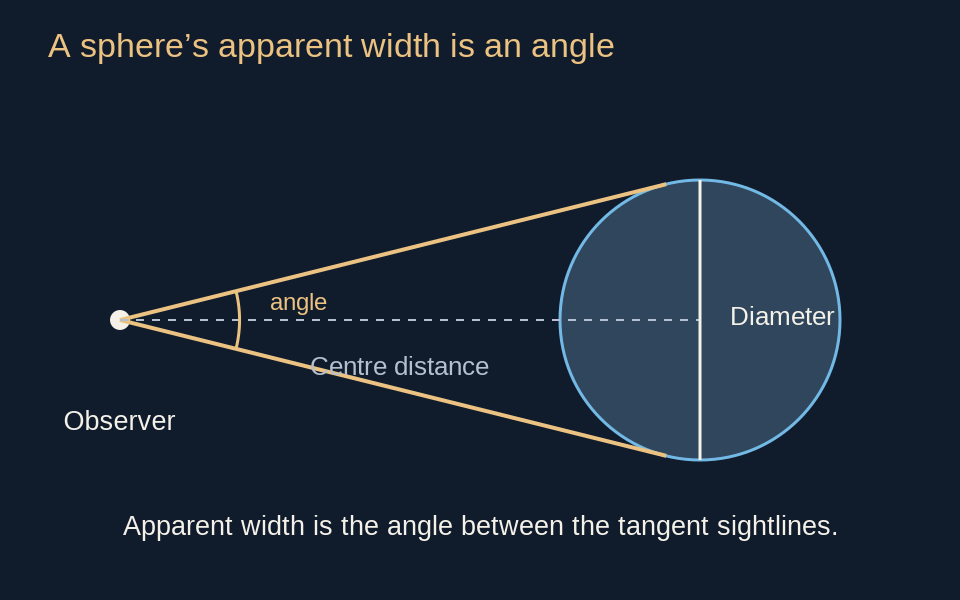
A telescope may collect light from two stars while its image fails to show two separate points. Resolution concerns distinguishable detail. Apparent size concerns the angle an object spans. This indoor model asks how a fixed spacing can become harder to distinguish when the viewing distance increases.
The cards are extended black marks on white paper rather than stars or a telescope image. Treat this as a model investigation. It is not a clinical eye test, a ranking of observers or a way to diagnose anyone’s eyesight. Choose a comfortable viewing position and use your usual glasses if helpful.
Make three controlled cards
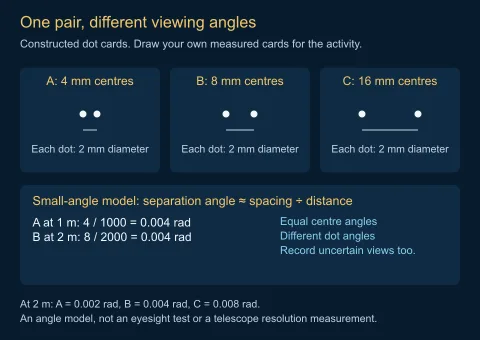
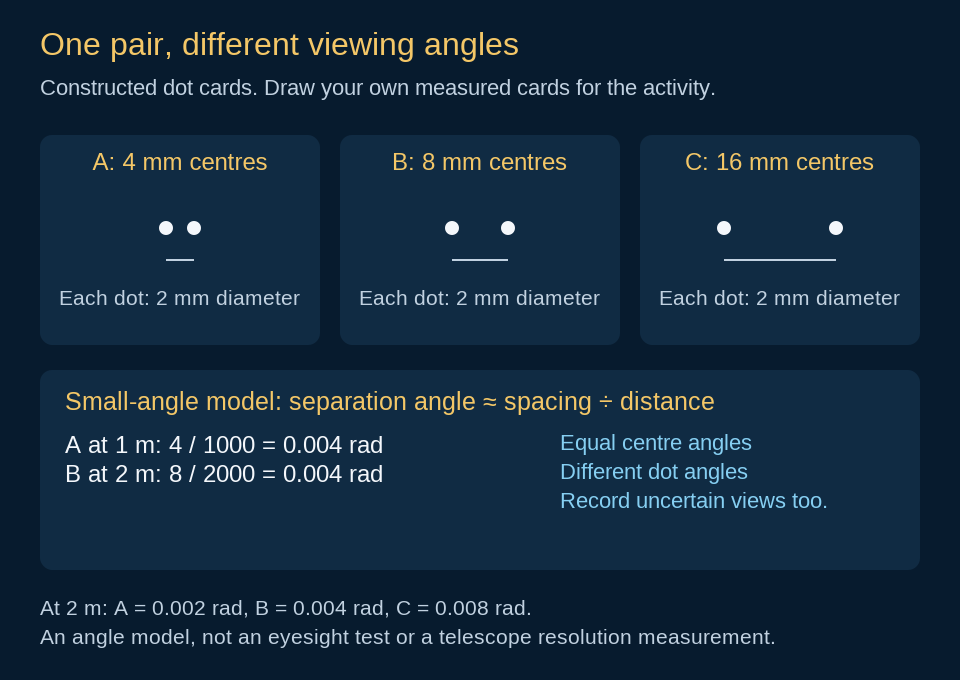
Use white paper, ruler, black pen, measuring tape, removable tape and a calculator. Draw three pairs of circular dots, each dot 2 mm across. Set centre-to-centre separations to 4 mm for A, 8 mm for B and 16 mm for C. Label the cards on the reverse so the front does not announce the expected order.
Tape one card at a comfortable height. Mark viewing positions 1 m and 2 m from its face along the same line. Keep room lighting, card orientation and dot size unchanged. Measure the drawn spacing rather than assuming every pen mark came out perfectly.
Record before explaining
At 1 m describe each card as two distinguishable dots, uncertain or merged. Repeat at 2 m with the same cards in a different order. Record uncertainty honestly. A partner can present the cards and record spoken descriptions. No learner needs to remove glasses or strain to produce a particular result.
Repeat one uncertain judgement after a short rest. If descriptions change, keep both entries and note the conditions. Do not fill the observation columns with an expected answer: the actual outcome depends on the marks, lighting and viewing system.
Compare angles with ratios
For small angles, angular separation in radians is approximately physical centre spacing divided by distance. Use millimetres for both. Card A at 1 m gives 4/1000 = 0.004 radians. Card B at 2 m gives 8/2000 = 0.004 radians. These two arrangements have equal approximate centre separation angles.
At 2 m the ratios for A, B and C are 0.002, 0.004 and 0.008 radians. Doubling distance halves the angular separation of a fixed pair. It also reduces each dot’s angular diameter, so equal separation ratios do not guarantee an identical-looking image.
State a limited conclusion
Write one claim supported by a named card, distance and observation. Explain which comparison changed distance alone and which changed dot spacing. Keep physical millimetres separate from angular radians in your conclusion.
A telescope’s detail also depends on aperture, wavelength, focus and observing conditions. Enlarging a blurred image does not automatically reveal missing detail. Your cards illustrate an angle comparison but do not measure a telescope’s diffraction limit.
PAUSE AND THINK
Must two equal separation angles produce identical dot-card views?
Explore the answer
No. Dot angular diameter, contrast and viewing conditions also matter. Equal spacing/distance ratios describe centre separation only.
RECORD YOUR OWN EVIDENCE
Your activity sheet
You need: White paper, ruler marked in millimetres, pencil, black pen, measuring tape, removable tape and calculator. A partner can describe the view if preferred.
Construct three dot-pair cards with equal 2 mm dot diameters and centre separations A = 4 mm, B = 8 mm and C = 16 mm. View in the same lighting at 1 m then 2 m. Record two dots, uncertain or merged. Calculate separation/distance using matching units.
Name or group: Date:
| Card / separation | At 1 m | At 2 m | Ratio at 2 m |
|---|---|---|---|
| A / 4 mm | |||
| B / 8 mm | |||
| C / 16 mm |
Which pair has the same approximate angular separation: A at 1 m or B at 2 m? Show the ratios.
Why can different descriptions of the same card be valid observations? What would you repeat?
Record what happened, including uncertain results. Use the answer guidance in this resource to discuss your explanation.