On this page
THE BIG IDEAS
- Test a seasonal explanation against both hemispheres.
- Keep the model’s axial direction consistent.
- Separate astronomical seasons from detailed regional weather.
Learning objectives
Students will connect Earth’s axial tilt with changing daylight and sunlight angle. They will test a proposed explanation against both hemispheres rather than one familiar weather pattern. Prepare a globe, cool LED lamp, paper orbital positions and a board with two claims: seasons come from changing distance, or seasons come mainly from axial tilt. This lesson addresses astronomical geometry, not the full explanation of local climate.
Set the lamp near the height of the globe’s centre. Keep the axis tilted about 23.5 degrees from vertical and pointed toward the same wall throughout. Mark locations around 45 degrees north and south. At equal-distance positions on opposite sides of the lamp, rotate the globe to compare their light angles and time spent in light. Secure the cable and keep the lamp out of direct sight.
Fifty-minute outline
- Minutes 0-8: Invite students to list local weather patterns and distinguish rainfall observations from the meaning of an astronomical season.
- Minutes 8-18: Present the fact that northern and southern mid-latitudes have opposite seasonal timing. Ask which claim can explain both at once.
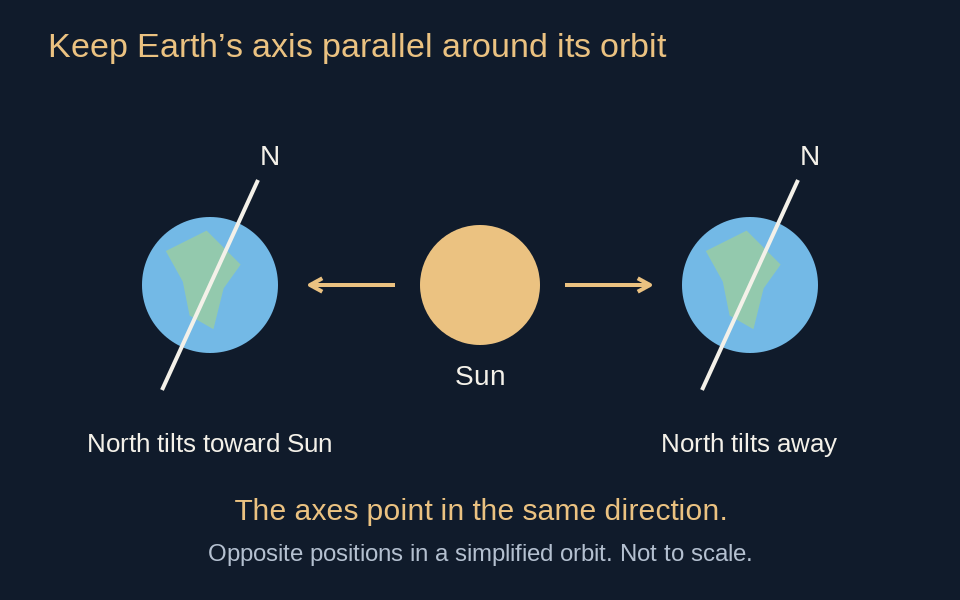
- Minutes 18-30: Model two opposite orbital positions with the axis kept parallel to one wall. Compare a marked northern and southern location.
- Minutes 30-40: Pairs write a claim-evidence-reasoning paragraph and annotate a two-position diagram.
- Minutes 40-50: Exchange explanations, identify one missing link and complete the exit prompt.
Questions for learners
Use the same three questions for every group so their reasoning can be compared. A ball can replace a globe if equator and pole markers are clear.
- 1. At the position where the north pole tilts toward the lamp, what changes for a northern mid-latitude observer?
- 2. What does the southern observer experience at that same position?
- 3. Why is carrying the globe around with its north pole always pointing at the lamp an invalid demonstration?
Teacher answer guide
The northern observer generally experiences longer daylight and more direct sunlight. The southern observer experiences the contrasting pattern. Keeping the north pole aimed at the lamp throughout the orbit removes the seasonal change in orientation; the model’s axis should remain approximately parallel as the globe moves.
Students may say closer means hotter because that fits everyday experiences with a heater. Acknowledge the reasoning, then ask whether it explains opposite seasons simultaneously. The value of evidence is that it can reject an otherwise plausible explanation.
Differentiation and a local connection
Provide pre-drawn parallel axes for students who struggle with spatial rotation. Challenge confident learners to explain why the equator and high latitudes respond differently. Ask the class to describe Karnataka’s monsoon pattern without forcing it into a temperate four-season diagram. The exit response should link tilt to both daylight duration and sunlight angle. Mark down unsupported claims that Earth’s orbit is a dramatically stretched ellipse or that distance alone determines local weather.
PAUSE AND THINK
What observation makes the distance-only explanation inadequate?
Explore the answer
Opposite hemispheres have opposite seasonal timing while sharing essentially the same Earth-Sun distance.
RECORD YOUR OWN EVIDENCE
Your activity sheet
You need: Globe or marked ball, cool LED lamp, tape and opposite orbital positions. Tilt the axis about 23.5 degrees from vertical and mark locations around 45 degrees north and south.
Keep the axes parallel while comparing opposite orbital positions.
Name or group: Date:
| Orbital position | Northern sunlight angle | Northern daylight | Southern comparison |
|---|---|---|---|
| North toward lamp | |||
| North away from lamp |
How do opposite hemispheres help you test an explanation?
How does the astronomical model differ from Karnataka’s seasonal rainfall pattern?
Record what happened, including uncertain results. Use the answer guidance in this resource to discuss your explanation.