On this page
THE BIG IDEAS
- Assess repeatability and agreement with the reference separately.
- Compare angles in one bearing at a known time.
- An uncertain threshold can be the correct conclusion.
Prepare stations and choose a clear outcome
Learners should be able to distinguish a predicted star altitude from a measured obstruction angle and explain when their comparison is uncertain. Set up eye-height marks for seated or standing observers. Work indoors with a protractor gauge and marked wall before any extension outside. Assign one learner to aim, one to read and one to record. Rotate roles and maintain the same sightline.
Allow 5 minutes for a sketch prediction, 12 for instrument setup and calibration, 12 for repeated measurements, 10 for a clearance discussion and 6 for the exit task. Planimetric diagrams and supplied data can replace the manual aiming role for a learner who prefers another way to participate.
Separate angle reading from geometry
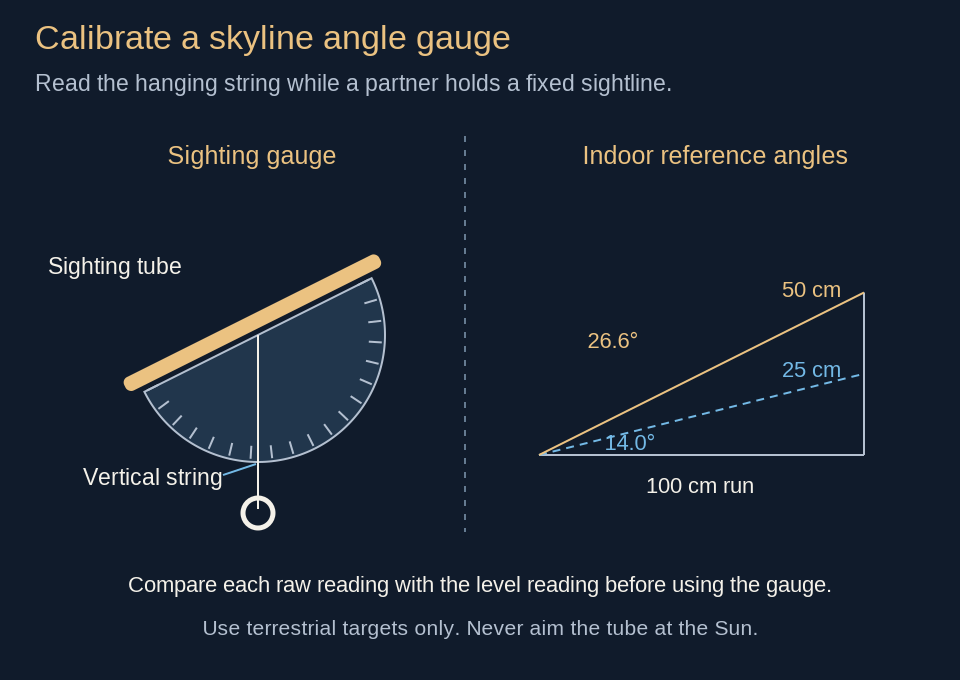
Ask learners to label the horizontal line, the vertical plumb line and the line of sight. Then check the 0 cm, 25 cm and 50 cm rise marks at a 100 cm run. The ideal answers are 0°, 14.0° and 26.6°. Show how a correctly level tool should have a raw reading close to 90° when its sightline is horizontal. Observe whether groups compensate for their actual measured zero.
Look for a rule used consistently on all three attempts. The range is a description of sample variation. Systematic error can remain even with repeated agreement. Invite one group to hold a slightly skewed straw briefly and explain why its repeated measurements sometimes stay consistent but cease matching the independent wall angles.
Discuss a decision close to the threshold
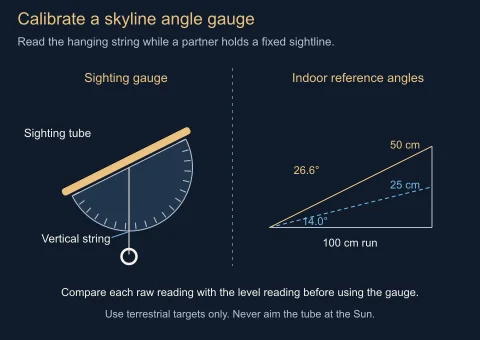
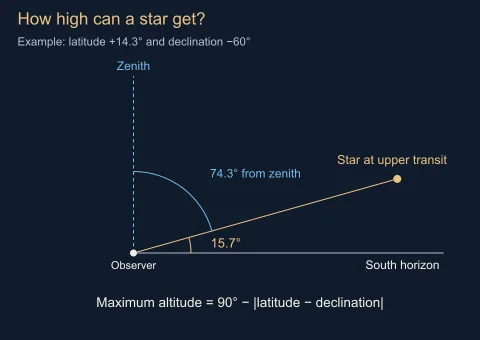
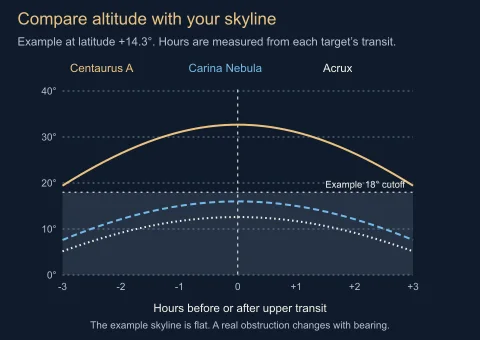
Use a star at +14.3° latitude and −60° declination. Its ideal maximum altitude is 15.7°. Groups who report obstruction angles of 9° to 11° have a clear geometric margin at transit in that bearing. A range from 14° to 17° straddles the prediction. In that case ask what extra evidence would justify a stronger decision.
An obstacle measured at a different bearing cannot be subtracted. Have groups place a tree to the southeast and compare it with a target predicted directly south. Then ask about a target that crosses the meridian at noon: a valid geometry calculation does not give a chance to see a star in a dark sky.
Assess the reasoning in an exit case
Give an observer latitude +20°, a star declination of −55° and three southern readings of 13°, 15° and 17°. The maximum altitude is 15°. The median obstruction is also 15° and the range crosses the threshold. An answer that claims an unobstructed view simply from the median needs further justification.
Award credit for the upper-transit calculation, the correct use of bearing, acknowledgement of the measured range and a next step such as checking a clearer horizon. As an extension, ask for two observing plans with identical star coordinates but different obstructions. Take any outside measurements from safe ground positions using terrestrial targets only.
PAUSE AND THINK
Can a worksheet show whether a star will be easy to see?
Explore the answer
It can support a geometric clearance decision. A real observation also depends on daylight, cloud, haze, sky brightness and the nature of the target.
RECORD YOUR OWN EVIDENCE
Your activity sheet
You need: A semicircular protractor, card, paper straw, tape, string, a small washer, metre tape and a pencil.
Compare each group’s calibration readings. Use the resulting evidence to discuss one clear margin and one range that straddles a predicted altitude.
Name or group: Date:
| Target | Rise | Run | Reference angle | Read 1 | Read 2 | Read 3 |
|---|---|---|---|---|---|---|
| Level | 0 cm | 100 cm | 0° | |||
| Low mark | 25 cm | 100 cm | 14.0° | |||
| High mark | 50 cm | 100 cm | 26.6° | |||
| Skyline or indoor target | Optional | Optional | Unknown |
Check the height prediction for latitude +20° and declination −55°.
What can you conclude from obstruction readings of 13°, 15° and 17°?
Which step changes if the obstruction and star have different bearings?
A student should give a numerical check and an observing decision backed by evidence.