On this page
THE BIG IDEAS
- Averted vision changes where a faint image falls on the retina.
- Improved detection does not guarantee resolved detail.
- Record intermittent and uncertain impressions rather than filling in expectations.
Give the visual system suitable conditions
Averted vision means looking slightly away from a faint target so its image falls outside the eye’s central viewing region. Under dim conditions, rod-rich parts of the retina can help detect weak light. This is a technique for faint-object detection, not a promise that every observer will gain the same amount.
Begin after allowing time for dark adaptation and reducing nearby glare. Use a familiar, safely located night-sky target well away from the Sun. Keep the observing position comfortable so unnecessary muscle strain and an unstable view do not dominate the comparison.
Start with a definite central reference
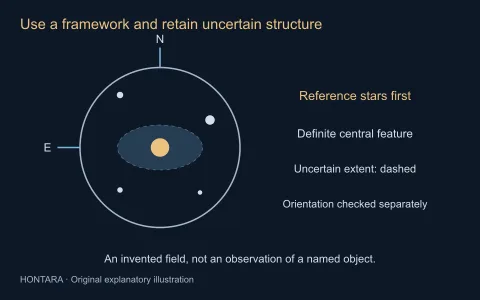
Centre a known field at a sensible low or moderate magnification and identify a definite star or landmark. Focus the telescope before evaluating a faint diffuse feature. Averted vision cannot recover detail lost through a badly unfocused image or turn an incorrect field identification into a detection.
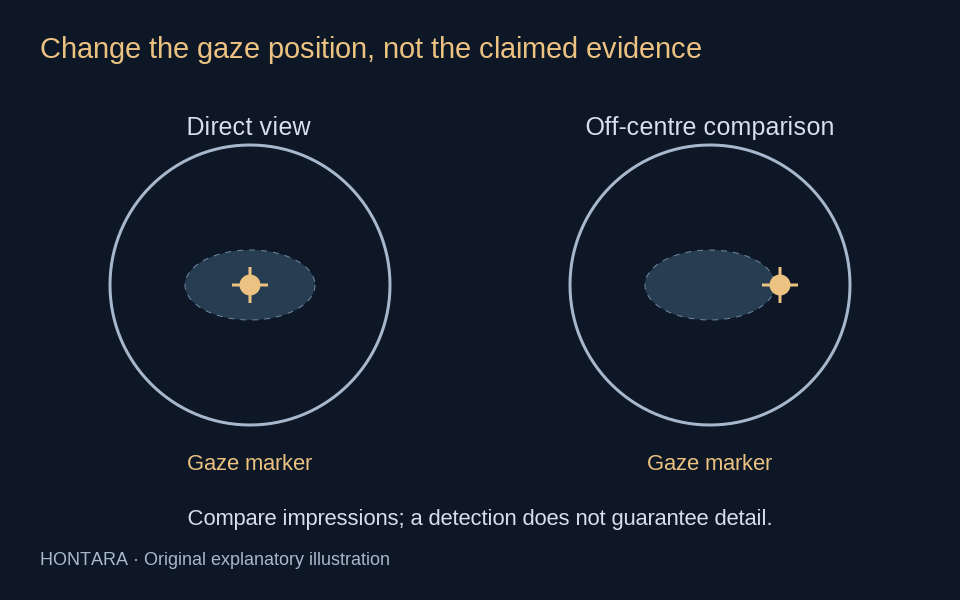
Look directly at the target, then shift the gaze slightly while keeping the same field. Try a few comfortable directions rather than assuming one fixed offset works for every eye and target. Avoid making extreme eye movements or forcing a view that is uncomfortable.
Compare brief repeated impressions
Alternate short periods of direct and off-centre viewing. Note whether a diffuse patch becomes more definite, stays uncertain or disappears. Let the eye move naturally between comparisons instead of staring rigidly at one point until an expected pattern seems to appear.
A hypothetical record might read direct: uncertain glow; off-centre: intermittent round patch. That wording retains useful evidence without asserting spiral arms or a boundary never securely seen. The aim is to improve observation quality, not to produce a more elaborate sketch than the conditions support.
Keep detection and detail separate
Averted vision can help notice that light is present without making its fine structure measurable. A patch that is intermittently detectable may not support a reliable shape, size or orientation. Record those questions separately rather than treating any increased visibility as permission to describe every feature in a reference photograph.
If you know the target’s famous appearance, write the initial impression before consulting an image again. Use labels such as definite, intermittent and uncertain. These are more informative than drawing a smooth outline around a feature whose extent could not be followed consistently.
Use the technique as one controlled comparison
Record magnification, optical setup, adaptation, sky conditions and whether averted vision was used. Try another observation later under improved conditions. A change in result can arise from several factors, so it should not automatically be credited to one technique alone.
People’s visual abilities and preferences differ. A shared observing session can include spoken descriptions, image displays or tactile materials alongside eyepiece viewing. The value of averted vision lies in making a specific comparison while keeping its limits visible, not in ranking people by how faint an object they can claim to see.
PAUSE AND THINK
If averted vision makes a galaxy detectable, does it automatically justify sketching its spiral arms?
Explore the answer
No. Detecting a faint patch and resolving its internal structure are different achievements. Record only the detail supported by repeated observations.